Comparison of high-flow humidified oxygen to the conventional continuous positive airway pressure in non-ventilated lungs during thoracic surgery: a randomized cross-over study
URL: https://www.jcvaonline.com/article/S1053-0770(21)00326-8/fulltext
DOI: https://doi.org/10.1053/j.jvca.2021.04.001
Published: Journal of Cardiothoracic and Vascular Anesthesia (April 7, 2021)
Authors: Prasert Sawasdiwipachai, Ratchaya Weerayutwattana, Punnarerk Thongcharoen, Sirilak Suksompong
Article description
Summary:
- Applying continuous positive airway pressure (CPAP) to the nonventilated lung is commonly used to prevent and treat hypoxemia during one-lung ventilation (OLV).
- However, CPAP use might prevent optimal lung collapse or promote reexpansion, which directly impairs surgical access, especially in video-assisted procedures.
- Few data are available on the efficacy of applying high-flow humidified oxygen (HFHO) to the nonventilated lungs of patients.
- The investigators aimed to study the efficacy of HFHO as an alternative method to CPAP in improving oxygenation while preserving lung deflation in the nonventilated lung during controlled OLV in paralyzed patients.
Summary
- Twenty-eight patients scheduled for elective pulmonary resection using OLV through thoracotomy or video-assisted thoracoscopic surgery were randomly assigned to receive nondependent CPAP of 5 cm H2O or HFNO (AIRVO2 to provide an FIO2 of 0.95 at 60 LPM.) for 20 minutes. The second intervention was then applied in a cross-over fashion for 20 minutes with a washout time of 20 minutes before each intervention.
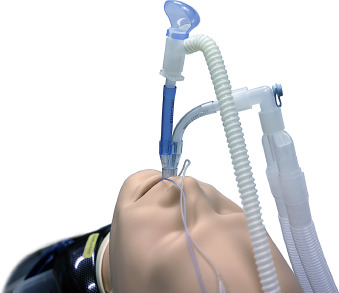
- The AIRVO2 tracheal direct connection can directly attach to the 15-mm DLT connector using a special oxygen flow meter to provide such a high flow (close to 60 LPM); however, this generates a significant level of noise.
- The primary outcome of this prospective randomized cross-over trial was the changes in gas exchange.
- The secondary outcome included the effect of each study intervention on lung deflation to facilitate the surgical conditions.
- One-lung ventilation was performed using a tidal volume of 6-to-8 mL/kg VT, PEEP of 5 cmH2O, and FIO2 of 1.0 with no lung recruitment maneuvers.
- Both CPAP and HFHO increased the partial pressure of arterial oxygen in either sequence in both groups, with non-statistically significant differences (95% confidence interval –12.84 to 21.87; p = 0.597).
- Compared with HFNO, the use of CPAP was associated with worsening of the surgical condition (the percentages of worse, no change, and improvement in surgical conditions in the CPAP group: 50, 46, and 4, respectively, HFNO group: 0, 61, and 39, respectively (p <0.001)).
- The cost considerations would favor the use of CPAP or apneic oxygenation, given that a CPAP device costs approximately $50. The HFHO involves a turbine machine with a heating element that costs roughly $4,000.
- Additional studies for cost-effectiveness and clinical application to the other OLV devices would be required to better characterize this new modality.