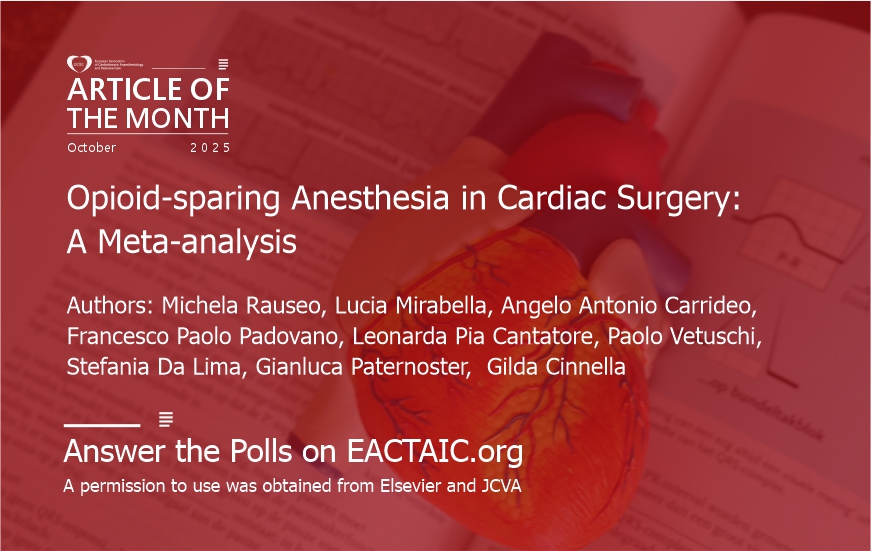
Opioid-sparing Anesthesia in Cardiac Surgery:
A Meta-analysis
Article summarized by Gabija Valauskaite, MD
DOI: https://doi.org/10.1053/j.jvca.2025.06.040
Published: Journal of Cardiothoracic and Vascular Anesthesia November 2025
Authors: Michela Rauseo, Lucia Mirabella, Angelo Antonio Carrideo, Francesco Paolo Padovano, Leonarda Pia Cantatore, Paolo Vetuschi, Stefania Da Lima, Gianluca Paternoster, Gilda Cinnella
Article description
Summary:
- This systematic review and meta-analysis aimed to evaluate the effects of opioid-sparing versus opioid-based anesthesia in adult patients undergoing cardiac surgery;
- Systematic review and meta-analysis of randomized controlled trials (RCTs) and observational studies;
- The study included 27 studies (8 RCTs and 19 observational cohorts) with a total of 58,998 adult cardiac surgery patients;
- The overall risk of bias was low to moderate, with moderate heterogeneity (I² = 38–67%) justifying the use of random-effects models across all analyses.
- Primary outcomes demonstrated significantly lower intraoperative and early postoperative opioid use in the opioid-sparing group compared with opioid-based anesthesia (pooled mean difference ?2.48 MME; 95% CI ?2.60 to ?2.35; p < 0.001).
- Opioid-sparing strategies were associated with a shorter ICU stay (OR 1.32; 95% CI 1.14–1.51), reduced mechanical ventilation duration (OR 1.46; 95% CI 1.24–1.72), and lower postoperative pain scores at 12 hours (OR 1.18; 95% CI 1.07–1.30).
- No significant difference in postoperative mortality was observed between the opioid-sparing and opioid-based groups (OR 0.20; 95% CI 0.04–1.14).
Conclusions:
- Opioid-sparing anesthesia in cardiac surgery significantly reduces opioid consumption, ventilation duration, and ICU stay without increasing short-term mortality.
- These findings support the incorporation of opioid-sparing anesthesia into enhanced recovery pathways, highlighting the importance of individualized, patient-centered, and opioid-conscious perioperative care.