Preoperative anemia and outcomes after corrective surgery in neonates with dextro-transposition of the great arteries
URL: https://www.jcvaonline.com/article/S1053-0770(21)00172-5/fulltext
DOI: https://doi.org/10.1053/j.jvca.2021.02.038
Published: Journal of Cardiothoracic and Vascular Anesthesia (February 17, 2021)
Authors: Vinzenz Boos, Christoph Bührer, Felix Berger
Article description
- The arterial switch operation (ASO) is a popular surgical corrective procedure of dextro-transposition of the great arteries (d-TGA), with perioperative survival reaching 95%-to-98%.
- Preoperative anemia is an independent risk factor for in-hospital mortality in neonates and older children undergoing noncardiac surgery.
- Low preoperative hemoglobin values were associated with acute kidney injury (AKI) in infants after congenital cardiac surgery.
- However, a large multicenter trial recently demonstrated that liberal transfusion thresholds did not reduce the likelihood of death or disability at 24 months of corrected age compared with restrictive transfusion thresholds in infants weighing less than 1,000 g at birth.
- The investigators aimed to study the association of preoperative anemia with adverse outcomes in neonates with d-TGA after ASO and to identify risk factors for preoperative anemia in a single-institutional cohort.
Summary
- Eighty-two patients younger than 28 days of age at admission with d-TGA, isolated or with additional cardiac malformations, who underwent ASO using bloodless priming of CPB were studied.
- Patients were classified according to the presence or absence of preoperative anemia.
- Compared with the infants in the control group, anemic infants before cardiac surgery were born more often by Caesarean delivery (57.1% v 24.6%, p = 0.014), had lower hematocrit and number of RBCs at birth, and received RBC transfusions more often during CPB course (81.0% v 34.4%, p < 0.001).
- The postnatal hematocrit value was the only variable independently associated with the appearance of preoperative anemia in multivariate logistic regression analysis (unit OR, 0.832; 95% CI, 0.743-0.931; p = 0.001).
- Infants with and without preoperative anemia had no statistical differences in the incidence of adverse events, duration of hospitalization (median 27 days v 26 days, p = 0.881), and mortality (0% v 4.9%, p = 0.566).
- This study has some limitations, including (1) the retrospective design, (2) the controversy about the definition of anemia, (3) excluding infants with preoperative transfusions, and (4) limiting the power of the analysis to assess the association between preoperative anemia and postoperative complications.
Conclusions:
- Untreated preoperative anemia was not associated with adverse outcomes in neonates undergoing reparative surgery for d-TGA.
- Further research is necessary to optimize perinatal, preoperative management of infants with d-TGA, to study the impact on outcomes in neonates with various types of congenital cardiac surgeries, to avoid preoperative anemia.
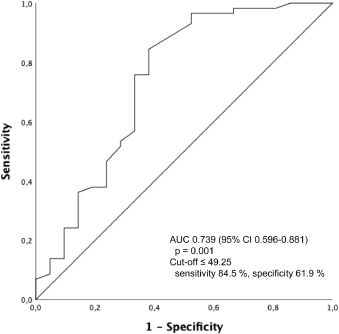
Receiver operating characteristics (ROC) analysis for the prediction of preoperative anemia by postnatal hematocrit. Based on ROC curve analysis, it was observed that a hematocrit lower than 0.4925 predicted preoperative anemia. AUC, area under curve.